
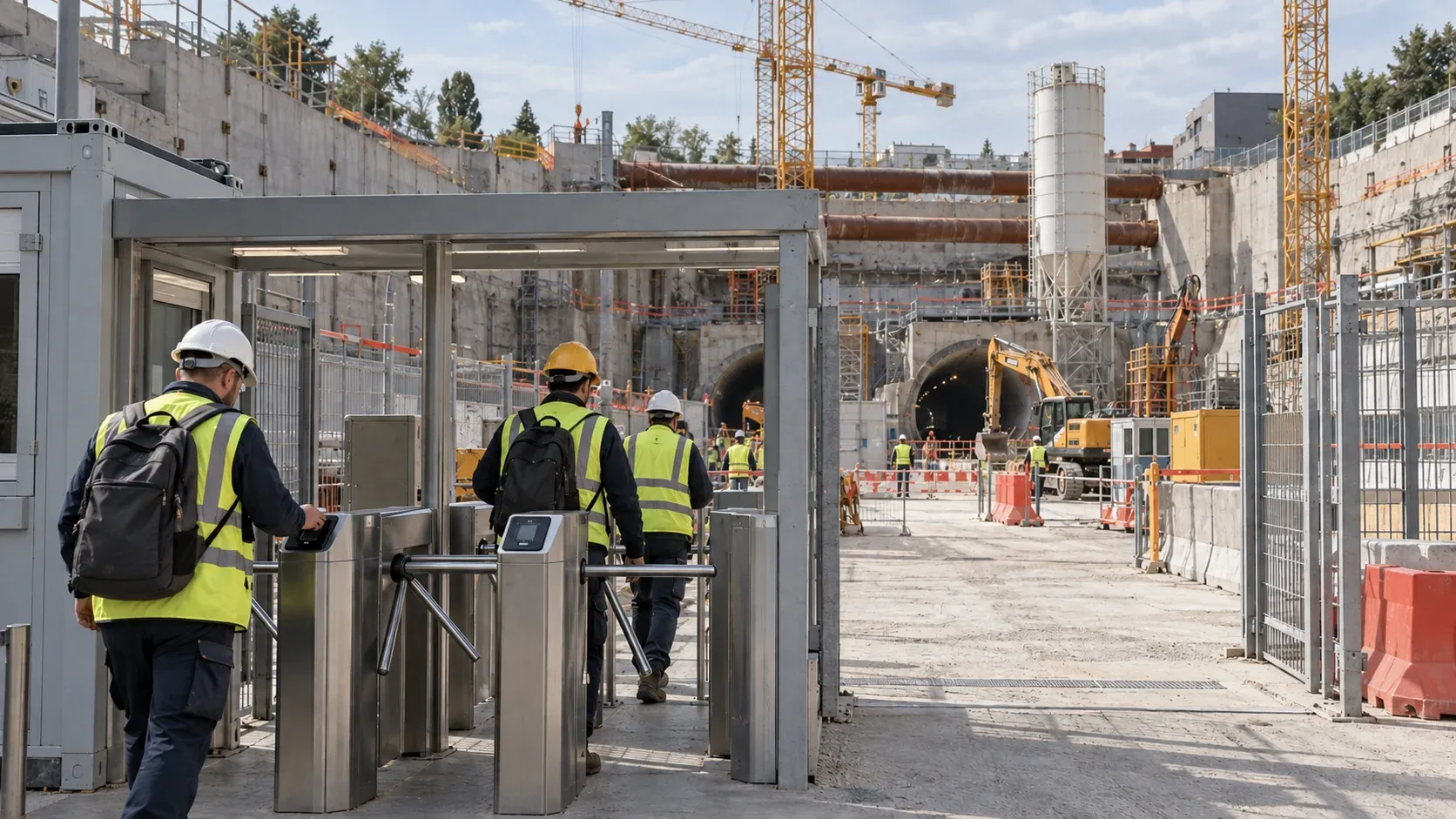
Timesheet Fraud Detection for a Metro Construction Consortium
- Client
- Construction consortium · Europe · metro line build, 1,200+ people through its site gates
- Industry
- Construction & Infrastructure
- Department
- Risk, Compliance & Audit
- Region
- Europe
Every clock-in stamped for an absent colleague is an hour paid for work nobody did, and with 61,000 time records a year nobody can spot it by eye. We built a UiPath robot that found the clock-ins too perfectly in sync to be honest and checked each one against 1.4 million site gate events. About 14% of the staff reviewed showed malicious clocking behaviour.
A working model of the approach on sample data. It plays on its own and pauses when scrolled away; nothing here touches a live system.
The results
- 14%
- of reviewed staff flagged for clocking fraud
- Audit finding reported by the delivery team, out of 154 employees reviewed.
- 61,000
- daily time records analysed
- 61,138 records for 154 employees over 13 months, parsed from the timekeeping report.
- 1.4M
- gate events cross-checked
- About 1.39 million access-control events across 98 site locations.
The challenge
Our client is a construction consortium building a metro line through the centre of a major European city: dozens of live sites, underground stations and shafts, and more than 1,200 people badging through the gates in a year. Staff clocked in and out on a timekeeping system, and everyone entering a site also passed an access-control gate. The two systems had never been compared.
That left room for two kinds of abuse: an employee clocking in or out for a colleague who was not there, known as buddy punching, and employees stamping more hours than they worked. The company commissioned an internal audit to find out how much of it was happening.
What it was costing them
- Paying for hours nobody worked. Every fraudulent stamp is paid as a worked hour, plus employer contributions.
- Invisible at scale. 61,000 daily time records and 1.4 million gate events a year cannot be compared by hand.
- Safety and site security. A person recorded as on site who is not, or the reverse, is a real problem on a live underground construction site.
- Contagion. Abuse that is never detected spreads, because colleagues see it go unchallenged.
- A weaker position on costs. On a project where labour cost is passed through and contested, inflated hours undermine every figure the company has to defend.
- Two clock-ins in one minute
- Compare with gate events
- One person on site
- One clock-in with no gate record
The approach
We built a UiPath robot as the analytics engine of the internal audit. It turned the company's own timekeeping reports into data, looked for clock-ins that were statistically too synchronised to be genuine, and tested every suspect against the access-control system.
From timekeeping report to audit evidence
- Report to data. The robot read the timekeeping report (PDF), parsed every employee block and day with pattern matching, and built a table of 61,138 daily records for 154 employees over 13 months: role, site, up to three entries and exits a day, and totals.
- Synchronised clock-in detection. For every day it compared each employee's entry and exit times with every other employee's, and flagged pairs who clocked in and out within 0, 1, 2, 3 or 4 minutes of each other: the signature of one person stamping two badges.
- Weekend-work check. Saturday and Sunday stamps counted per employee as a second indicator.
- Cross-check against the gates. Every suspect's recorded shifts were checked, month by month, against roughly 1.4 million access-control events across 98 site locations, to confirm whether the person actually passed the gate.
- Evidence for the auditors. Results written to workbooks per check and per time interval, with the matching gate events alongside, so the audit team could review every case.
- 61,138 daily time records
- < 30 matching pairs per interval
- 14% of 154 staff flagged
From thousands of coincidences to a reviewable list
Same-minute entries alone are common on a busy site: more than 2,000 entry-only coincidences at zero minutes apart. Requiring both entry and exit to match cut that to fewer than 30 pairs per interval, and the gate cross-check then put each suspect's own badge events beside the clock record. The auditors reviewed evidence, not a statistic.
Built for the investigation
Fast, single-purpose analytics run under audit direction, on records the company already held, rather than a permanent production robot.
Technology
| Layer | What we used |
|---|---|
| Automation and analytics | UiPath Studio, data-table and Excel activities, VB.NET |
| Document parsing | PDF text extraction, regular expressions |
| Sources | Timekeeping report (PDF), access-control export (Excel, monthly) |
| Output | Audit evidence workbooks per check and interval |
The outcome
The audit team got what it could never have produced by hand: every suspect clock-in, side by side with the gate record that confirms or contradicts it.
| Before | After | |
|---|---|---|
| Timekeeping vs site access | Never compared | Reconciled for 13 months |
| Scope of the check | Not feasible by hand | 61,138 time records and ~1.4M gate events |
| Buddy punching | Invisible record by record | Flagged at 0-4 minute intervals |
| Evidence | No systematic check | A workbook per check, with the matching gate events |
- About 14% of the employees reviewed showed malicious clocking behaviour.
- Several hundred hours paid but not worked uncovered over the period reviewed. At an average construction labour cost of about €24 an hour, that is roughly €7,000–€22,000 (our estimate).
- 13 months of timekeeping and 1.4 million gate events reconciled, an exercise that is not feasible by hand.
- Evidence per case for the internal audit investigation.
The risk most teams miss
A timekeeping system checks that a badge was used, not who used it. Fraud that relies on a colleague's hand looks perfectly normal record by record; it only shows when records are compared with each other and with a second, independent system. The other trap is employee-monitoring law: checks on staff are regulated, GDPR included, so the analysis has to run on records the company already lawfully holds, under an audit mandate, with findings reviewed by people before anything is acted on.
Built with
The tools this ran on, by the layer each one carried.



Related work
 Energy & Utilities20+automations in productionIntelligent Automation Program for an Italian Multi-UtilityListed multi-utility · Italy · five provinces, energy, water, waste and public servicesRead the case
 Public Sector3evidence sources cross-checked per projectEU Grant Expense Verification Automation for an Italian RegionRegional government · Italy · managing authority for EU structural fundsRead the case
 Construction & Infrastructure< 1 dayProjectedmanagement reporting, down from 30ERM Platform for Road ConstructionRoad-construction group · Bulgaria · ~300 staff, €100M+ revenue, own asphalt, concrete and fuel sitesRead the case
Next step
Start the same conversation
Tell us the process that keeps breaking. We will come back with what it would take to fix it, what it would cost, and what we would measure.
Or write to us directly: •••••@•••••••.•••
- A reply from a partner within one business day
- Fixed scope and fixed fee, agreed before we start
- The maps and the backlog are yours either way